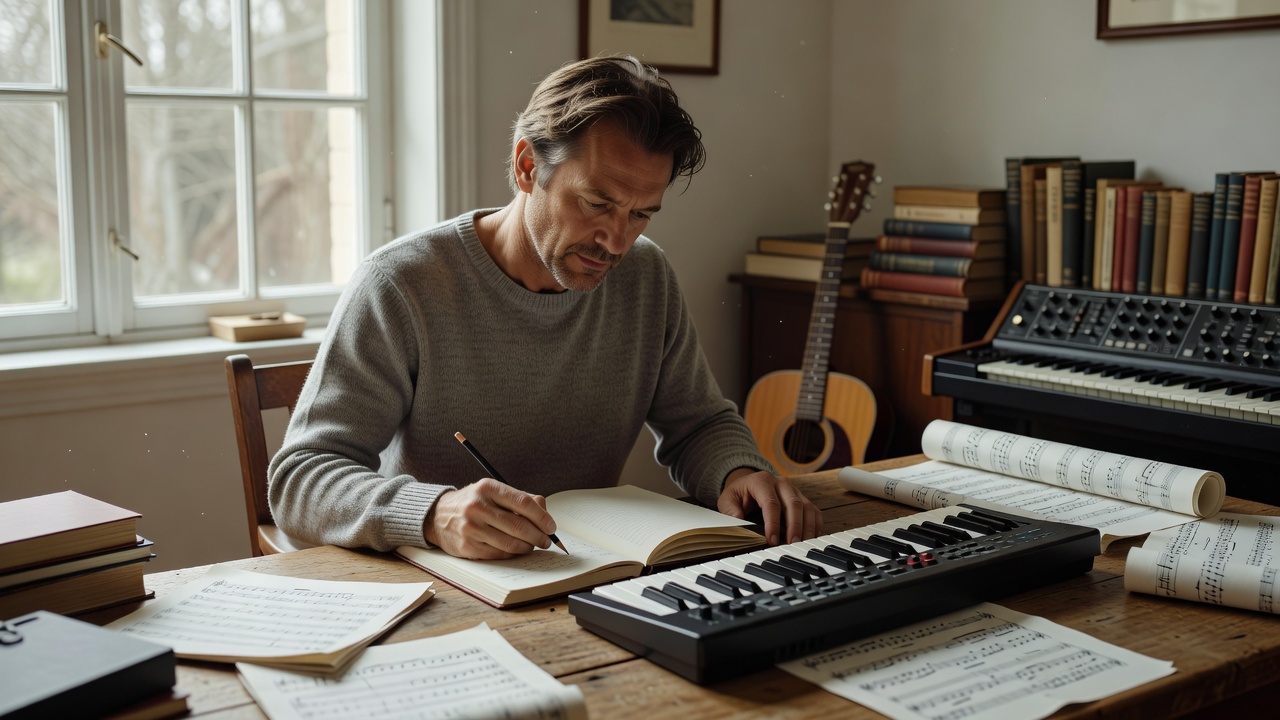
Begin with a playable verb
A musical brief becomes useful when it describes behaviour. “The player is searching a familiar room for something that has changed” gives more direction than “mysterious, but cosy”. It tells the composer there is recognition, patient observation and a small disturbance. Record what the player can do, what they know, and what they should not yet know. A score can support uncertainty without telling the player that a reveal is imminent.
Choose one representative moment and attach a short gameplay capture. Explain whether its pacing is typical or artificially tidy. If the game is not playable yet, use a storyboard and state the assumptions. The aim is not to remove interpretation; it is to make interpretation discussable. Ask the composer to paraphrase the scene's purpose before presenting a musical solution.
Translate emotion into a vocabulary
Agree on a few musical dimensions: register, rhythmic activity, instrumental texture, harmonic stability and density. A direction such as “low rhythmic activity, a narrow melodic range and occasional unresolved colour” can be explored without committing to an expensive recording setup. It also leaves room for the composer to suggest an identity that is not already embedded in a reference track.
Separate constants from variables. Perhaps the lead instrument should remain recognisable across the game, while rhythm and accompaniment can change with player pressure. Perhaps harmony should stay ambiguous, but a warmer register can mark safety. These rules form a small musical vocabulary. They become especially valuable when another arranger, implementer or sound designer joins the project later.
“During unhurried exploration, keep the player curious rather than alarmed; let environmental clues remain audible, and reserve the strongest rhythmic activity for confirmed danger.”
Listen to references for decisions
References are most productive when everyone knows what is being borrowed conceptually. In the official soundtrack for Bastion, by Darren Korb, listen for how a distinctive instrumental palette can establish a world. That is a useful discussion prompt, not a request to reproduce its melodies, recordings or signature combinations.
Celeste, by Lena Raine, offers another listening exercise: compare the emotional character and density of contrasting tracks, then ask which musical dimensions your own game needs to change. Undertale, by Toby Fox, is a useful reference for discussing recurring melodic identity. These soundtrack releases document the music and credits; they do not, by themselves, document every runtime implementation detail.
Keep a reference sheet small. For each selection, write a timestamp, a useful quality and an explicit exclusion. “Listen to the spacious opening; do not imitate the melody or instrument patch” is clearer than an unannotated playlist. If references disagree, discuss the disagreement now. A team cannot approve a single cue against three incompatible expectations.
Approve a representative slice
Commission a short prototype that includes the ordinary state and one meaningful change. It might contain an exploration loop, a tension layer and an exit. Review it against gameplay, not only in a music player. A cue that feels understated alone may be exactly right under footsteps and dialogue. A richly detailed arrangement may compete with a visual clue the player must notice.
Make feedback specific and prioritised. “The low pulse makes this room feel hostile before anything happens” identifies a problem. “Make it more magical” leaves the composer guessing. Group comments into emotional fit, musical identity and technical behaviour. Name one person who consolidates team feedback so the composer is not reconciling contradictory notes from several channels.
Write down the approved decisions
A good handoff includes the scene description, reference notes, prototype version, expected transitions and unresolved questions. Record what approval means: permission to extend the vocabulary, approval of the arrangement, or acceptance of a final asset. These are different decisions. A prototype approval should not silently become a promise that no implementation changes will ever be needed.
Also record constraints. List the expected release platforms, recording resources, accessibility concerns and approximate production schedule. If speech carries important information, say so. If the game includes a music-volume control, assume the experience must remain understandable with the score reduced or muted. Finally, carry the brief into the next stage: a musical vocabulary is only useful if its rules can survive the player changing direction.